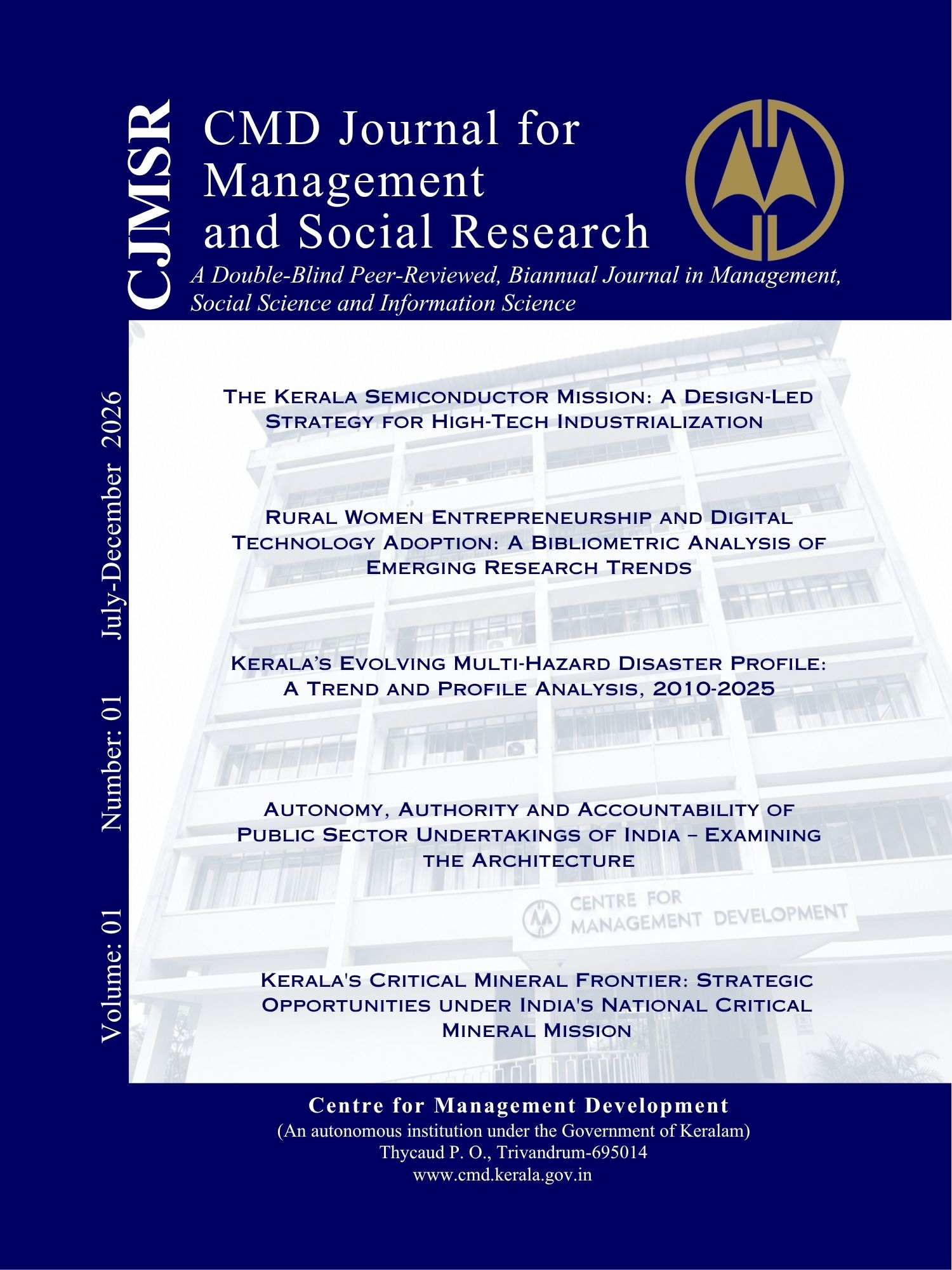
The Kerala Semiconductor Mission: A Design-Led Strategy for High-Tech Industrialization
Keywords:
Kerala Semiconductor Mission (KSM), Path Creation Theory, Regional Innovation Systems, Resource-Based View, Circular Economy, High-Tech Industrial Policy.Abstract
This paper explores the industrial pathway for Kerala in the context of the national mandate on high-tech manufacturing. While India has several key value chain nodes to address that require different resources, Kerala has a severe lack of land, a historical lack of risk capital, and outward regional brain drain. Drawing upon the authors’ previous institutional research and supported by industry consultations, this study tries to address the situation and put forward a solution through the lens of four theoretical frameworks: Resource-Based View, Path Creation, Regional Innovation Systems, and Circular economy principles.
By bypassing traditional industries like low-cost volume manufacturing and focusing on knowledge-intensive design-based industries, Kerala can utilise a viable and non-replicable model of development. The state’s sticky knowledge assets, primarily the large STEM workforce and a specialised diaspora pipeline, constitute the base. Furthermore, advanced material recovery and urban mining would add value and help bridge the infrastructure gaps that may persist. Finally, this paper outlines a ten-year roadmap for the implementation of the autonomous Kerala Semiconductor Mission that would propel the industry through targeted interventions like subsidised Electronic Design Automation tool access, demand creation through public procurement, and establishment of robust domestic IP and its protection.
References
Asheim, B. T., & Isaksen, A. (2002). Regional Innovation Systems: The integration of local ‘Sticky’ and global ‘Ubiquitous’ knowledge. The Journal of Technology Transfer, 27(1), 77–86. https://doi.org/10.1023/a:1013100704794
Centre for Management Development. (2026). Report on semiconductors: Kerala (Limited distribution report). Government of Kerala.
Cooke, P. (2001). Regional innovation systems, clusters, and the knowledge economy. Industrial and Corporate Change, 10(4), 945–974. https://doi.org/10.1093/icc/10.4.945
Das, P. (2026, February 1). Union Budget 2026 bets on critical minerals, nuclear energy, advanced science. Down to Earth. https://www.downtoearth.org.in/sciencetechnology/union-budget-2026-bets-on-critical-minerals-nuclear-energy-advancedscience
DeLeon, H. (2023). What is Semiconductor Technology and Why Is It Important?. https://www.usf.edu/continuing-education/lifelong-learning/news/2023/
what-is-semiconductor-technology-and-why-is-it-important.aspx
Department of Science and Technology. (n.d.). India Semiconductor Mission (ISM). India Science, Technology, and Innovation Portal. Retrieved March 17, 2026, from https://www.indiascienceandtechnology.gov.in/st-visions/nationalmission/india-semiconductor-mission-ism
Garud, R., & Karnøe, P. (2013). Path dependence and creation. In R. Garud & P. Karnoe (Eds.), Path dependence and creation (pp. 1–38). Routledge.
https://doi.org/10.4324/9781410600370
Gereffi, G., Humphrey, J., & Sturgeon, T. (2005). The governance of global value chains. Review of International Political Economy, 12(1), 78–104.
https://doi.org/10.1080/09692290500049805
Graedel, T. E., Harper, E. M., Nassar, N. T., & Reck, B. K. (2013). On the materials basis of modern society. Proceedings of the National Academy of Sciences, 112(20), 6295-6300. https://doi.org/10.1073/pnas.1312752110
Lee, K., & Lim, C. (2001). Technological regimes, catching-up and leapfrogging: Findings from the Korean industries. Research Policy, 30(3), 459–483.
https://doi.org/10.1016/s0048-7333(00)00088-3
Mathews, J. A., & Cho, D. (2000). Tiger technology: The creation of a semiconductor industry in East Asia. Cambridge University Press.
https://doi.org/10.1017/cbo9780511552229
Mazzucato, M. (2018). Mission-oriented research & innovation in the European Union: A problem-solving approach to fuel innovation-led growth. European Commission, Directorate-General for Research and Innovation. https://doi.org/10.2777/36032
Ministry of Micro, Small & Medium Enterprises. (n.d.). Public procurement policy. Retrieved June 2, 2026, from https://msme.gov.in/public-procurement-policy
NITI Aayog. (2026). Future of India's semiconductor industry. https://www.niti.gov.in/sites/default/files/2026-05/Future-of-India-Semiconductor
Industry.pdf
Parthasarathi, A., & Joseph, K. (2002). Limits to innovation with strong export orientation: The case of India’s information and communication technologies sector. Science Technology and Society, 7(1), 13–49. https://doi.org/10.1177/097172180200700103
Perez, C., & Soete, L. (1988). Catching up in technology: Entry barriers and windows of opportunity. In G. Dosi, C. Freeman, R. Nelson, G. Silverberg, & L. Soete (Eds.), Technical change and economic theory (pp. 458–479). Pinter Publishers. Retrieved May 30, 2026 from https://archive.org/details/technicalchangee0000unse
Peters, M. A. (2022). Semiconductors, geopolitics and technological rivalry: The US CHIPS & Science Act, 2022. Educational Philosophy and Theory, 55(14), 1642–1646. https://doi.org/10.1080/00131857.2022.2124914
Sydow, J., Schreyögg, G., & Koch, J. (2009). Organisational path dependence: Opening the black box. Academy of Management Review, 34(4), 689–709.
https://doi.org/10.5465/amr.34.4.zok689
Teece, D. J., Pisano, G., & Shuen, A. (1997). Dynamic capabilities and strategic management. Strategic Management Journal, 18(7), 509–533.
https://doi.org/10.1002/(SICI)1097-0266(199708)18:7%3C509::AID-SMJ882%3E3.0.CO;2-Z
Velenturf, A. P.M., & Purnell, P. (2021). Principles for a sustainable circular economy. Sustainable Production and Consumption, 27, 1437–1457.
Downloads
Published
Issue
Section
License
Copyright (c) 2026 CMD Journal for Management and Social Research

This work is licensed under a Creative Commons Attribution-NonCommercial 4.0 International License.